
Drone-Future
Engineering the missing link in autonomous drone delivery
Drone delivery is often presented mainly as a challenge of autonomous flight. Considerable attention is given to range, navigation, battery performance and the ability of a drone to transport a parcel through the air.
Drone delivery is often presented mainly as a challenge of autonomous flight. Considerable attention is given to range, navigation, battery performance and the ability of a drone to transport a parcel through the air.
But reaching a destination is only part of the delivery process.
Where can the drone approach and dock safely? How can a parcel be transferred without requiring the recipient to handle the aircraft? How can deliveries be made to houses, apartment buildings, warehouses and logistics facilities? And how can the same infrastructure support outgoing shipments and returns?
Drone-Future was conceived to address this missing link between the flying vehicle, the building and the user.
The original concept was created by Ivan Peeters, with Inventus carrying out the majority of the original concept development, mechanical engineering and early product development. Rather than focusing on the drone as an isolated product, the project examined the complete infrastructure required to make autonomous delivery practical.
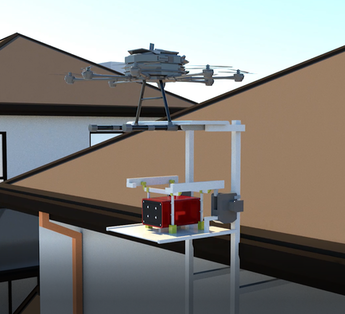
The resulting concept combines an elevated docking location with a cargo-transfer mechanism and a secure parcel-receiving system.
A drone can approach and dock at a controlled position on or near a building. The parcel can subsequently be transferred away from the aircraft and towards a location that is safely accessible to the recipient. This limits the need for drones to land at ground level, where people, animals, vehicles and other obstacles may be present.
The same principle can also support outgoing parcels and product returns. A user can place a parcel into the receiving infrastructure, after which it can be transferred to a drone without requiring direct interaction with the aircraft.
This two-way functionality is essential for a genuinely autonomous logistics network. A complete delivery system must connect the drone, its cargo, the building and the recipient as one coordinated process.
Developing such a system required several engineering disciplines to come together. Inventus worked on the mechanical architecture, docking principles, cargo handling, elevator and transfer mechanisms, safety considerations and integration into different types of buildings.
The infrastructure also needed to accommodate variations in drone design, cargo modules, installation environments and delivery procedures. A solution for a private home will not necessarily have the same dimensions or capacity as a system installed at an apartment building, warehouse or logistics centre. The underlying architecture therefore had to offer sufficient flexibility for different configurations.
This system-level approach led to a patented cargo-delivery architecture. United States patent US 10,730,621 B2, titled “System and method for cargo delivery,” was granted on 4 August 2020. The formal patent record names Bart Jean Marie Goovaerts, Ivan Jos Christine Peeters and Kris Rottiers as co-inventors, with Drone-Future BVBA identified as the assignee.
The patented architecture covers the interaction between an aerial vehicle, cargo, a docking station and a user-accessible delivery location. It also considers elevated docking, autonomous parcel transfer and different installation and delivery configurations.
The project illustrates the difference between developing an individual component and designing an operational system. Autonomous drone delivery cannot be made practical through flight technology alone. It also requires infrastructure that allows cargo to move safely between the aircraft and the physical environment in which people live and work.
Drone-Future is preparing a 2026–2027 pilot initiative intended to take this architecture into a new phase of practical validation. The ambition is to create a broadly applicable interface for rooftops, external walls, residential buildings, commercial properties, warehouses and logistics environments.
For Inventus, Drone-Future represents system innovation in its most complete form: identifying an unsolved operational problem, creating an original architecture, developing its critical mechanical elements and translating the complete concept into protectable technology.
Originally conceived by Ivan Peeters. Developed primarily through Inventus. Designed to connect autonomous aerial transport with real buildings and real users.
All news