
Polyfyx
Reinventing one of the world's most familiar fastening principles
Fasteners are found in almost every industry. Buttons, press studs, zippers and hook-and-loop systems are used in clothing, footwear, medical products, automotive components, consumer goods and countless technical applications.
Fasteners are found in almost every industry. Buttons, press studs, zippers and hook-and-loop systems are used in clothing, footwear, medical products, automotive components, consumer goods and countless technical applications.
Because these systems have existed for generations, fastening can appear to be a largely solved problem. In practice, however, conventional solutions still have significant limitations.
Some create noise when opened. Others collect dirt or fibres, damage delicate materials, require multiple production steps or are difficult to integrate into curved and rigid components. Many standard fasteners also offer limited freedom to adjust the connection force or adapt the mechanism to the geometry of a specific product.
Polyfyx began with the idea that a fastening system should not be treated as a separate standard component. Instead, its geometry should be adaptable to the product in which it is used.
The original Polyfyx principle was invented by Ivan Peeters and developed primarily through Inventus. Inventus transformed the initial idea into a configurable connection technology through extensive mechanical development, material experimentation, prototyping and application research.
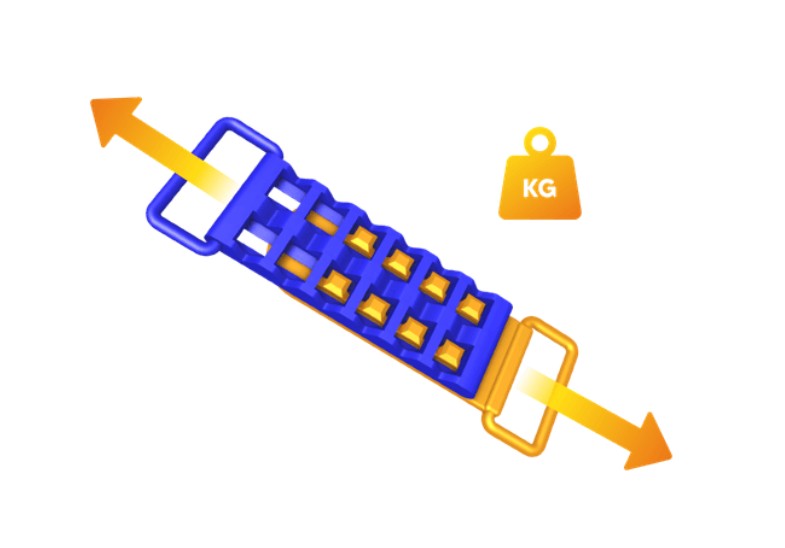
The technology consists of two corresponding elements. One side contains flexible coupling pins with retaining features, while the opposite side contains specially designed openings and supporting ribs. When both sides are pressed together, the elements deform in a controlled manner before mechanically locking into position.
The result is a secure but releasable connection.
The behaviour of the fastener can be adjusted by modifying the number, dimensions and geometry of the pins, lips, openings and supporting structures. Material hardness, flexibility, surface shape and the arrangement of the connection points can also be adapted to the intended application.
This makes it possible to engineer the connection force rather than accepting the fixed characteristics of an existing standard fastener.
A lightweight textile application may require a different feel and release force from a medical device, a shoe component or a rigid industrial product. Polyfyx provides a common technical principle that can be configured for these different circumstances.
The fastening elements can be produced in flexible or more rigid materials and integrated through techniques such as injection moulding, sewing or ultrasonic welding. In certain applications, the geometry can be moulded directly into the product component. This may reduce the need for additional parts and separate assembly operations.
The system was also developed to address practical shortcomings of existing fastening technologies. It can operate without the characteristic tearing sound of hook-and-loop systems and can be designed to resist the accumulation of fibres and dirt. Depending on the materials selected, the connection can also be made washable and suitable for repeated use.
These characteristics create potential applications in sectors such as footwear, textiles, healthcare, consumer electronics, automotive products, packaging and construction.
The development resulted in an international intellectual-property portfolio. United States patent US 12,564,249 B2, titled “Composite fastener,” was granted on 3 March 2026. The patent identifies Ivan Peeters as inventor and describes a removable fastening system based on flexible coupling pins, overhanging retaining features, corresponding recesses and supporting ribs.
Polyfyx demonstrates how Inventus approaches innovation: begin with a familiar product principle, identify limitations that others have accepted as unavoidable and use mechanical design, materials knowledge and prototyping to create an adaptable alternative.
What began as a new fastening idea has therefore developed into a versatile connection technology that can become part of the product itself.
Invented by Ivan Peeters. Developed primarily through Inventus. Protected through an international patent portfolio.
All news